



CPH:DOX SUMMIT 2026 TAKE AWAYS
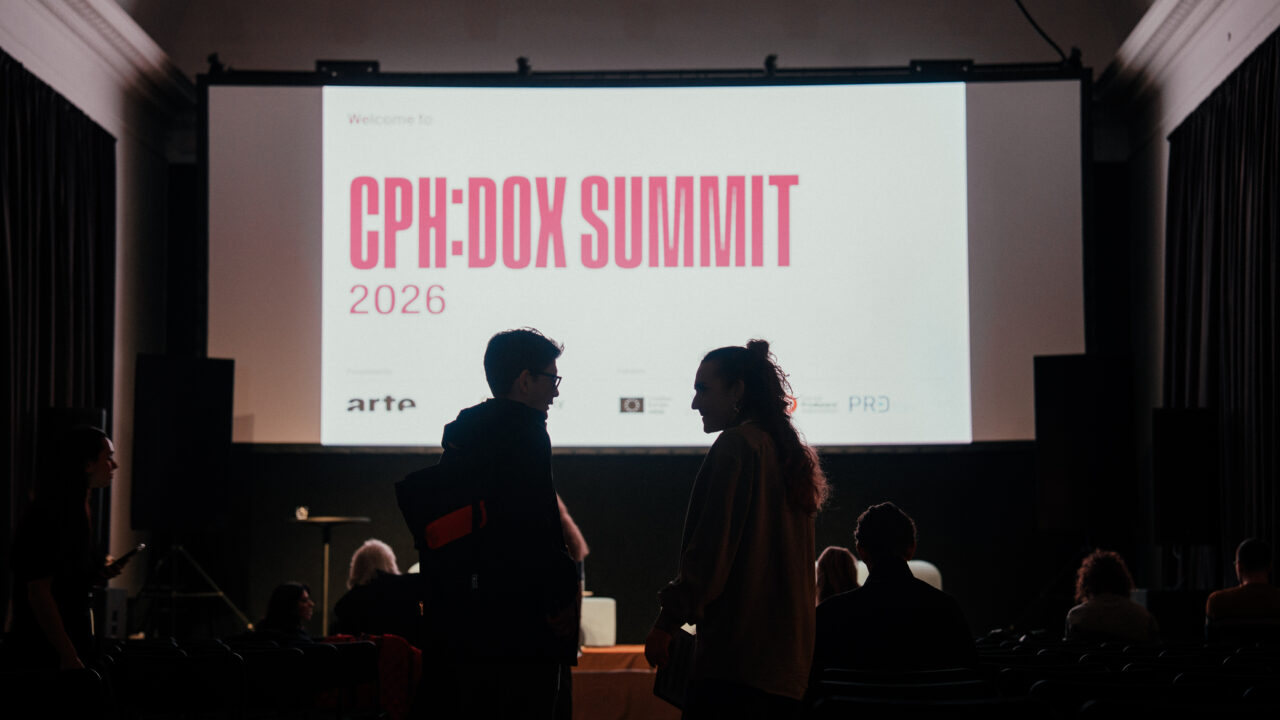
MONDAY, MARCH 16 marked the second edition of the CPH:DOX SUMMIT at Social Cinema, Kunsthal Charlottenborg — a day charged with urgency, exchange, and forward-thinking dialogue.
From the keynote by Bruno Patino, Head of Arte France, presented by ARTE in partnership with Doc Society, to a series of sharp, future-facing conversations, the Summit dug deep into what lies ahead for the audiovisual field.
Discussions were rich and wide-ranging: from building independent media infrastructures to rethinking the future of distribution, and drawing vital lessons from fields like journalism that can meaningfully reshape documentary filmmaking and the wider audiovisual industry.
Curated by Danielle Turkov Wilson, Mark Edwards, and Sameer Padania, and hosted by Beadie Finzi, CPH:DOX SUMMIT 2026 brought together voices committed not just to understanding change, but to actively shaping it.
Read Amy Shepherd’s (Chief Operating Officer, Think-Film) key take ways from the CPH:DOX SUMMIT 2026 down below:
The CPH:DOX Summit 2026 opened with a prediction by AI engine Claude on what the state of media in the public interest will look like in 2030. It was pretty bleak.
But we are an industry of creative people, who were never just going to follow the AI.
The Summit was brought together to open our eyes, articulate what we want, and map out paths for how we get there. In listening to the discussion to note down learnings and action takeaways, I felt that speakers were collectively representing our human voice countering the AI – and that became what follows: Claude vs M.A.U.D (i.e. “Me And U Decide”).
We are MAUD, and the power is within us.
Documentary is about opening our eyes, bringing new perspectives, and building bridges (and bringing hope!) – so that’s what I aim in this discussion synthesis to offer. 2030 is now only 4 years away – the time to change course is short, but changes can happen quickly.
It no longer takes a village to make change, it takes an *army*. We are here, we are human, and we believe that democracy is still worth fighting for!
So, first – Claude said that in 2030 public service broadcasters have become hollowed out to be simply commissioning entities.
I’m sorry Claude, but that’s just not going to happen.
Because MAUD said that with the films we are making, with the industry and infrastructure choices we are making, we are building a world that protects unique voices, ensures we are still telling good stories, and helps us bring these to audiences in smarter and more efficient ways.
A first major step has already happened: led by ARTE, broadcasters have joined together in a new network coalition to make sure that audiences have access to trusted, fact-based stories.
Right now, film funders are working to structure more innovative, collaborative, systemic models.
And fillmmakers still want to work with broadcasters – it’s just that as the majority of audiences are now using social media as the gateway to film content, producers are pushing for more agile and flexible agreements so they can use multiple channels to reach big audiences.
To prepare for the future, we are learning from former tech insiders, who are revealing the tips of the AI trade, and teaching us how to use data ethically.
In MAUD’s 2030, we are using existing AI protocols to create systems that work for us. And we are building collectively-owned infrastructure – that doesn’t strip audience data and freedom, but instead listens to, serves, and most importantly, *nourishes* us as audiences and citizens.
Second, Claude said that in 2030 factual content is dying, and prestige docs are all that survive. Investigative, socially-urgent docs are rare.
Yes, people are under pressure, and state and corporate tactics are trying to silence media, but that’s not the whole story.
MAUD said that we have not stopped speaking truth to power. We can be encouraged that:
– Journalists are not giving up, they are prepared to suffer to do what they do best.
– Activists, particularly young people, are defying authoritarian regimes and risking their lives to protest.
– Funders are committed to giving journalists and activists cover, support, and resources, as best they can – and those with deep pockets are stepping up to meet increasing needs.
– People on the frontlines are working with documentary filmmakers to bring their stories to much bigger audiences, in deeply impactful ways.
As we reclaim our identity and narrative, our role as Europeans is also to support the rest of the world to do the same – and as we work towards 2030 the creative content infrastructure we build is increasingly connecting culture both within and beyond Europe.
According to MAUD, in 2030 the fight for documentary continues! Producers are being entrepreneurial, and strategic impact production has become mainstreamed to help filmmakers build routes to audiences intentionally, relationally, and from the very beginning.
Third, Claude said that by 2030 synthetic content is abundant – people don’t know what is true, and only watch stuff they really trust.
This is a real problem, but MAUD says that AI is still imperfect and greater human connection is what we need!
In fact, human storytellers are the architects of the future.
– Journalists are learning from content creators how to be visible, and “show their working” to build audience trust.
– Journalists and artists are working together to make stories that are both authentic and entertaining.
– We are using technology to build communities and networks – so the community becomes the business model, and audiences can have many sources of information they can trust.
According to MAUD, in 2030, as now, we are opposing the power of data with the power of imagination.
Finally, Claude said that in 2030 there is no common information experience. People find content by following creators they personally trust.
Yes, trust is key. And MAUD told us that in a world of digital isolation, physical spaces are becoming increasingly vital, providing for people who crave face-to-face interactions.
Documentaries are growing as social and cultural infrastructure.
Public space infrastructure is being bought by creative land trusts to protect the presence of progressive things in society, and give real substance to what it means to curate shared experiences.
According to MAUD, by 2030 we will see the true expression of the “relationship economy” – people tired of AI synthetics desire real, human, relationships, and the sense of connection and community built by moments such as collective film viewing is re-growing democracy, as people can feel and see there is something worth holding onto.
So Claude’s world isn’t inevitable. A better future is possible!
We’ve discovered today that MAUD’s world is one in which…
– We talk about difficult topics, and try our best to build dialogue and find compromise solutions.
– We take risks despite being uncomfortable, or deeply afraid.
– We stand with and fight for people around the world, because in this connected world their struggles are our problem too.
– We act together.
– We make many small choices for good and having massive cumulative impact.
According to MAUD, our long experience in the documentary field of collaborating and coordinating is a north star for others on how to push back against structures of power.
The Kenyan gentleman said “We have systems, like the machines, but they don’t work.” We can change that.
My concluding thought: in the lead-up to 2030 we are discovering that now it is OUR time to “move fast and break things” – to counter the speed at which AI is learning and shaping reality, to break our enslavement to the machine, to strike back against the power of money, and to build a world that is better for us all to live in.
Thank you MAUD, for showing that we must, can, and will do this!